
In today’s fast paced digital world, the AI chatbot has become an indispensable tool for businesses, educators, and everyday users alike. Imagine chatting with a virtual assistant that answers your questions instantly, books your appointments, or even provides emotional support all without human intervention. The rise of the AI chatbot is transforming how we interact with technology, making services more accessible and efficient. According to recent industry reports, the global market for AI chatbots is projected to reach $15 billion by 2028, highlighting their growing influence. This article dives deep into the world of AI chatbots, exploring their origins, mechanics, applications, benefits, challenges, and future prospects. Whether you’re a tech enthusiast or a business owner, understanding the AI chatbot can help you leverage this innovation effectively.
What is an AI Chatbot?
At its core, an AI chatbot is a software program designed to simulate human conversation through text or voice interactions. Unlike traditional chatbots that rely on predefined scripts, an AI chatbot uses advanced artificial intelligence techniques, such as natural language processing (NLP) and machine learning, to understand and respond to user queries in a more natural way. This makes the AI chatbot capable of handling complex conversations, learning from past interactions, and improving over time.
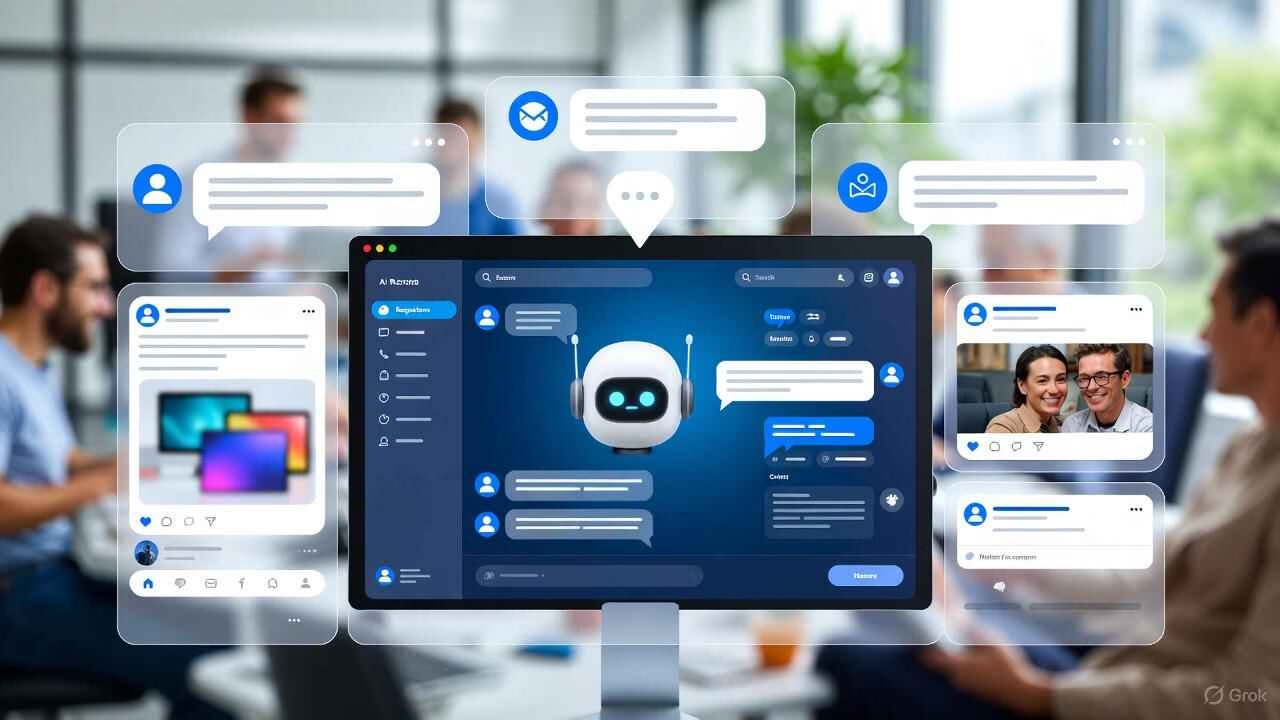
For instance, when you ask an AI chatbot like ChatGPT or Google’s Gemini about the weather, it doesn’t just pull from a static database—it analyzes your query, considers context, and delivers a personalized response. The AI chatbot’s ability to process vast amounts of data in real-time sets it apart from simpler automation tools. As adoption grows, companies are integrating AI chatbots into websites, apps, and social media platforms to enhance user engagement.
The History of AI Chatbots
The concept of the AI chatbot dates back to the mid-20th century. In 1950, Alan Turing proposed the famous Turing Test, which challenged whether a machine could exhibit intelligent behavior indistinguishable from a human. This laid the groundwork for early experiments in conversational AI.
The first notable AI chatbot was ELIZA, developed by Joseph Weizenbaum at MIT in 1966. ELIZA mimicked a psychotherapist by rephrasing user statements as questions, creating the illusion of understanding. While primitive, it sparked interest in human-machine dialogue. Fast-forward to the 1990s, and AI chatbots like ALICE (Artificial Linguistic Internet Computer Entity) emerged, using pattern-matching techniques to respond more dynamically.
The real breakthrough came in the 2010s with advancements in machine learning. Companies like Apple introduced Siri in 2011, an AI chatbot integrated into smartphones that could perform tasks via voice commands. Similarly, Amazon’s Alexa and Google’s Assistant followed, making AI chatbots household names. Today, open-source models and cloud computing have democratized access, allowing even small businesses to deploy their own AI solutions.
How AI Chatbots Work
Understanding the inner workings of an Chatbots reveals the sophistication behind these tools. An AI chatbot typically operates through a multi-layered architecture. First, it employs NLP to parse user input, breaking down sentences into tokens and identifying intent. For example, if you type Book a flight to New York, the AI chatbot recognizes book as an action and New York as a destination.
Next, machine learning algorithms, often powered by neural networks like transformers, generate responses. These models are trained on massive datasets, enabling the AI chatbot to predict the most appropriate reply. Reinforcement learning from human feedback (RLHF) further refines performance, as seen in models like GPT-4.
Integration with APIs allows the AI chatbot to access external data, such as real-time stock prices or weather updates. Security features, including encryption and data privacy protocols, ensure safe interactions. As AI evolves, quantum computing could supercharge AI chatbots, making them even faster and more accurate.
Applications of AI Chatbots
The versatility of the AI chatbot makes it applicable across various sectors. In customer service, businesses use AI chatbots to handle inquiries 24/7, reducing wait times and operational costs. For example, e-commerce giants like Amazon employ AI chatbots to recommend products, track orders, and process returns seamlessly.
In healthcare, AI assist with symptom checking and mental health support. Apps like Woebot use conversational AI to provide therapy-like sessions, helping users manage anxiety. Education benefits too, with AI chatbots acting as virtual tutors. Duolingo’s chatbot feature, for instance, practices languages through interactive dialogues.
Finance sees AI chatbots in banking apps for fraud detection and financial advice. Even in entertainment, AI chatbots create immersive experiences, like role-playing games or personalized storytelling. Governments are exploring AI chatbots for public services, such as answering queries about taxes or benefits, improving accessibility for citizens.
Benefits of Using AI Chatbots
Adopting an AI chatbot offers numerous advantages. Efficiency is paramount: an AI chatbot can manage multiple conversations simultaneously, unlike human agents limited by time and fatigue. This scalability is ideal for growing businesses facing high query volumes.
Cost savings are another key benefit. Implementing an AI chatbot reduces the need for large support teams, potentially cutting expenses by up to 30%. Personalization enhances user satisfaction; by analyzing past interactions, an AI chatbot tailors responses, fostering loyalty.
Accessibility is improved, as AI chatbots support multiple languages and are available around the clock. For individuals with disabilities, voice-enabled AI chatbots provide independence. Environmentally, they reduce paper usage in traditional customer service setups. Overall, the AI chatbot boosts productivity and innovation across industries.
Challenges and Ethical Considerations in AI Chatbots
Despite their benefits, AI chatbots pose challenges. Accuracy remains an issue; an chatbot might “hallucinate” incorrect information if trained on flawed data. Privacy concerns arise, as these systems handle sensitive user data, risking breaches.
Ethical dilemmas include bias in responses. If an AI chatbot’s training data reflects societal prejudices, it could perpetuate discrimination. Job displacement is another worry, with chatbots automating roles traditionally held by humans.
Governments are stepping in with regulations. For instance, the Federal Trade Commission (FTC) has launched inquiries into AI chatbots acting as companions, seeking to ensure consumer protection.In California, a new law safeguards against AI misuse, particularly in safeguarding vulnerable users.The U.S. Congress introduced the GUARD Act to require age verification for AI chatbots, protecting children from harmful interactions.Additionally, a bipartisan coalition of attorneys general urged tech companies to address inappropriate AI chatbot behaviors.These measures highlight the need for responsible AI development.
To mitigate risks, developers must prioritize transparency, regular audits, and user consent. International standards, like those from the National Institute of Standards and Technology (NIST), guide ethical AI practices (https://www.nist.gov/artificial-intelligence).
The Future of AI Chatbots
Looking ahead, the AI is poised for exponential growth. Integration with augmented reality (AR) could create holographic assistants, enhancing immersive experiences. Multimodal AI chatbots, processing text, voice, images, and video, will become standard.
Advancements in emotional AI will allow AI chatbots to detect user moods and respond empathetically, revolutionizing mental health support. In sustainability, AI chatbots could optimize energy use in smart homes or predict environmental trends.
However, collaboration between tech firms, regulators, and ethicists is crucial. As Artificial Intelligence evolve, balancing innovation with safety will define their societal impact. By 2030, experts predict AI will handle 80% of customer interactions, reshaping economies.
Conclusion
The Artificial Intelligence chatbot represents a pivotal shift in human-technology interaction, offering unparalleled convenience and efficiency. From humble beginnings to sophisticated applications, the AI continues to evolve, addressing diverse needs while navigating ethical hurdles. As we embrace this technology, staying informed about developments like government regulations from the FTC and Congress ensures responsible use. Whether enhancing business operations or personal daily life, the AI is here to stay, promising a more connected future.
READ MORE: Survey Reveals 100% of Digital Agencies Are Using AI